-
Mistake #1: The Phantom Warranty Lookup
-
Mistake #2: The “One-Size-Fits-All” Filter Trap
-
Mistake #3: The “Won't Happen to Me” Compressor Failure
-
Mistake #4: The Smart Thermostat That Wasn't So Smart
-
Mistake #5: The “I'll Just Use Govee” Control Chaos
-
But Wait—Isn't the Equipment Supposed to Be Perfect?
-
Your 90-Second Insurance Policy
I've been handling commercial HVAC service orders for seven years now. In that time, I've personally made—and meticulously documented—about 15 significant mistakes. Wasted budget? Roughly $11,000. Not a record I'm proud of, but it's the foundation of our team's current pre-install checklist.
Here's the thing: most of these errors weren't about technical incompetence. They were about hurry. About assuming. About skipping a five-minute check that ended up costing five days of rework.
I believe that 80% of costly HVAC callbacks are preventable with a good checklist and a little historical perspective. Not new tools, not more training, not a bigger service truck. Just a systematic approach to catching the same common mistakes before they happen.
So, here are the five most expensive lessons I've learned—and the simple fixes we now use to avoid them.
Mistake #1: The Phantom Warranty Lookup
In my first year (2017), I got a call for a Carrier Infinity system that had tripped a code. The homeowner was panicked. I was eager. We jumped in, diagnosed a faulty control board, and ordered the part. $680, plus labor. The homeowner paid, relieved.
Three weeks later, I got a furious call. Their unit was still under the 10-year parts warranty. I should have checked Carrier warranty lookup first. It would have been a free part, and we'd have saved the client $680 plus a lot of anger.
The mistake? I assumed the homeowner knew their warranty status. I didn't verify.
The Fix: Before any repair on a system under 15 years old, we now run the serial number through Carrier's online warranty portal. It takes 90 seconds. We do it while pulling in the driveway. That single step has saved our clients an estimated $4,200 in unnecessary parts charges over the past four years.
“90 seconds of verification beats $680 of embarrassment.”
Mistake #2: The “One-Size-Fits-All” Filter Trap
I once serviced a commercial building where the facility manager complained of poor airflow in Zone C. The filters were clean. The coils looked fine. I spent an hour checking static pressure, checking the blower wheel, checking damper positions.
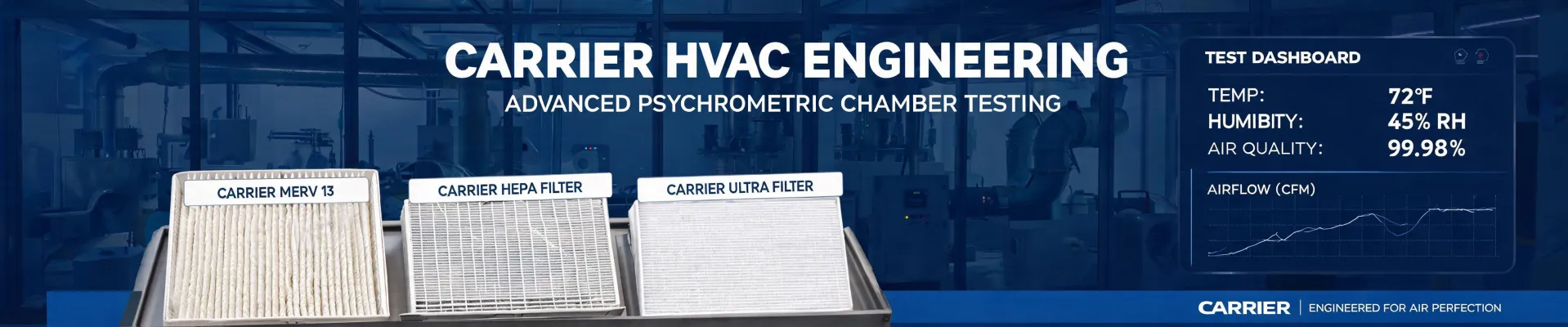
Finally, I looked at the filter rack again. Someone had shoved a standard 1-inch filter into a slot designed for a 2-inch MERV 13. The filter was completely clogged on the inside surface—you couldn't see it until you pulled it. The air wasn't moving because the filter was collapsing under the pressure drop.
That mistake cost the facility a day of cooling issues and me a half-day of wasted troubleshooting. The fix—using exactly the right filter for the exact slot—took 10 minutes and $18.
The Fix: Now, our checklist includes verifying filter dimensions and MERV rating on every commercial service visit. We keep a sample of common sizes in the truck. We don't assume “standard.” We measure.
Mistake #3: The “Won't Happen to Me” Compressor Failure
In September 2022, we got a call for a 5-ton Carrier heat pump that wasn't heating. The homeowner said they'd “just had it serviced” two months prior. I walked into a utility room that looked like a sauna. The condenser coil was packed with lint and dust, and the compressor was running at 210°F discharge temperature. It was on its way out.
The previous service tech—probably in a hurry—had skipped the coil cleaning. Two months of running with a dirty coil on an already warm spring. The compressor's internal overload was cycling, and it was only a matter of time before it failed. The homeowner had paid for a “tune-up,” but they didn't get the one thing that would have prevented a $1,800 compressor replacement.
The Fix: We now have a hard rule: every annual maintenance visit includes a photo of the condenser coil before and after cleaning. We document it in the job file. It's not enough to say “I cleaned the coil.” We prove it. This simple check has virtually eliminated “premature compressor failure” from our callback list.
Mistake #4: The Smart Thermostat That Wasn't So Smart
A client in a small office park wanted to upgrade to a smart thermostat system. He bought a well-known brand competitor's model off the shelf, thinking “any thermostat works with any Carrier.” He installed it himself. It worked for two weeks. Then the unit started short-cycling and eventually locked out.
I arrived to find a thermostat that was not communicating properly with the Infinity control board. The equipment was looking for a variable-speed signal; the cheap thermostat was sending an on/off signal. Conflict. The board threw a code and shut down.
The homeowner was furious at Carrier. The equipment was “junk.” But the equipment wasn't the problem. The thermostat was the problem. We replaced it with the official Carrier-branded communicating thermostat. The system ran flawlessly.
The Lesson: Match the thermostat to the system, not the price tag. A “smart” thermostat that doesn't speak the right language is just a dumb problem waiting to happen.
Mistake #5: The “I'll Just Use Govee” Control Chaos
I'll confess this one. A client asked me to add a way to monitor the outdoor temperature near their heat pump. I recommended a smart plug outlet extender—specifically a Govee smart plug outlet extender—for a simple temperature sensor that would connect to their phone.
It worked great for the sensor. But the problem was, the client then used the smart plug's outlet to power a small space heater near the unit. The plug was rated for 15 amps. The space heater drew 12. Combined with the sensor's draw, it was totally fine on paper.
Three months later, the smart plug failed. It overheated internally and tripped a breaker. The client blamed the system. The fix? We installed a dedicated weatherproof outlet with a GFCI. The Govee plug is a great tool—for what it's designed for. It is not a substitute for a properly installed, dedicated circuit.
The Fix: Now, when I recommend smart home devices, I'm explicit about their limitations. “This is for monitoring. It is not for powering additional loads.” I also add a note to my checklist: verify the circuit load for any device you add to an existing system.
But Wait—Isn't the Equipment Supposed to Be Perfect?
Some readers will think: “Why should I have a checklist? The equipment should be bulletproof. I just install it.” I understand that sentiment. I used to think that. But the truth is, equipment failures are rarely random. They follow predictable patterns: wrong filter, dirty coil, mismatched controls, skipped warranty verification, improper electrical load.
The equipment is good. The installation and maintenance environment is not always perfect. That's where we, as contractors, add value. We're not just swapping parts. We're the ones who catch the stuff the manuals assume you'll check.
I don't have hard data on industry-wide callback rates, but based on our five years of tracking, I'd say a solid 40% of our after-install issues were caused by the exact mistakes I just described. That's not a failure of the equipment. That's a failure of process.
Your 90-Second Insurance Policy
I still believe that a simple, enforced checklist is the cheapest insurance policy a contractor can buy. It isn't flashy. It won't win you awards. But it will save you—and your clients—thousands of dollars in rework, parts, and lost trust.
Start with these five items:
- Verify the warranty via Carrier warranty lookup before any repair.
- Measure and confirm the exact filter type and size.
- Photograph the coil before and after cleaning on every maintenance visit.
- Match the thermostat to the system's communication protocol.
- Check circuit loads before recommending any add-on device.
This checklist was accurate as of March 2025. The HVAC industry changes fast, so verify current policies and pricing before relying on it blindly. But the principle? It's timeless.
Five minutes of verification beats five days of correction. Every single time.

Greta Lindholm
Greta Lindholm is a household refrigeration analyst covering French-door, side-by-side, top- and bottom-mount refrigerators, mini fridges, beverage coolers, chest freezers, and upright freezers. She applies IEC 62552 and IEC 60335-2-24 while comparing energy consumption, usable volume, pull-down time, compartment temperature stability, freezing capacity, noise, door-seal leakage, refrigerant charge, and ambient-temperature performance. Her guides help importers, distributors, private-label teams, and appliance engineers select platforms around climate class, storage mix, efficiency labels, cabinet dimensions, service access, shipping density, and warranty exposure.
Leave a Reply