
-
Comparison Framework: Old Rules vs Current Reality
-
Dimension 1: Is a 2.5 Ton Unit the Right Size—or Is Bigger "Safer"?
-
Dimension 2: Carrier COR Thermostat vs Basic Programmable
-
Dimension 3: HVAC Filter vs Standalone Air Purifier
-
Dimension 4: AC Power Draw vs a Small Chest Freezer
-
So Which Way Do You Go?
I'm a quality and brand compliance manager at an HVAC contractor. I review every installation before it goes to the customer—roughly 220 systems a year. So far in 2025, I've rejected about 7% of first-time installs for things that had nothing to do with the equipment itself: thermostat wiring, filter access, and oversized condensers.
This article is a comparison, not a sales pitch. I want to walk through the decisions that actually matter when you're putting in a Carrier 2.5 ton AC unit, and where the Carrier COR thermostat fits. I'll compare the old way and the new way, because what was best practice in 2020 doesn't always hold in 2025.
Comparison Framework: Old Rules vs Current Reality
Here's the thing about most AC decisions: people compare the wrong things. They compare brand names and price quotes, but the real differences are in sizing method, control strategy, and maintenance access. So I'm going to compare those three dimensions directly.
- Sizing: 2.5 ton vs 3 ton—what the load calculation actually says.
- Thermostat: Carrier COR vs a basic programmable thermostat.
- Maintenance: HVAC filtration vs standalone air purifiers.
If you're a contractor or a facility manager, these are the conversations you're already having. Let's get into the first one.
Dimension 1: Is a 2.5 Ton Unit the Right Size—or Is Bigger "Safer"?
Five years ago, I saw a lot of "go bigger to be safe" thinking. A 1,500-square-foot house with a two-ton load would get a 2.5 ton unit. A house that needed 2.5 tons would get three. The logic was simple: if it's hot outside, more capacity is better.
The reality is the opposite. Oversized AC cools the air too fast, skips the dehumidification part of the cycle, and then short-cycles. In humid climates, that means a house that feels cold but clammy. In any climate, it means more wear on the compressor.
I had a trigger event in 2023 that changed how I talk about this. A customer had a 3-ton unit on a roughly 1,400-square-foot home. It kept shutting down on summer afternoons. The compressor wasn't the problem. The house never got a long enough run cycle to pull humidity down, so it felt miserable. We replaced it with a Carrier 2.5 ton AC unit, because that's what the load calculation said. Problem solved.
The fundamentals haven't changed—proper load calculation, clean filters, good airflow—but the execution has transformed. Manual J is no longer optional. It's how you avoid callbacks.
I don't have hard data on industry-wide oversizing rates, but based on the installs I review, I'd guess 25% to 30% are oversized. A lot of buyers focus on the brand and SEER rating and completely miss the sizing method. The question everyone asks is "what size do I need?" The question they should ask is "what does the load calculation say?" According to ACCA (acca.org), Manual J is the industry standard for residential load calculation, and it exists for a reason.
Bottom line for this dimension: a 2.5 ton unit is not a compromise. If the load calculation says 2.5 tons, bigger is a red flag, not a safety net.
Dimension 2: Carrier COR Thermostat vs Basic Programmable
This is where I see the biggest change. A basic programmable thermostat still works: you set a schedule, it follows it. But it treats the AC like a light switch. The Carrier COR thermostat is designed to talk to the system, not just switch it on and off.
The COR adds geofencing, humidity setpoints, and diagnostic alerts. For Carrier Infinity systems, the COR is the brain that makes the communicating feature work. For a variable-speed system, that's a real difference. The thermostat can tell the compressor to ramp up or down, and it can tell you when airflow is off. I've rejected installs because the COR thermostat was mounted where the sun hit it, and I've rejected installs because the wiring wasn't set up for the communication bus. The equipment was fine. The control was the problem.
Does every job need a COR thermostat? Probably not. For a basic single-stage Carrier 2.5 ton AC unit, a simple programmable stat might be enough. But if you're putting in a variable-speed system, the COR is, in my opinion, worth it. It took me about 300 inspections to understand that the best-looking install isn't always the best-controlled one.
One small thing: keep the manual where you can find it. I've watched installers spend ten minutes searching a job site while the homeowner had a drawer full of manuals—the Philips Norelco hair clipper manual, a Shark air purifier quick start—somewhere in there—but not the thermostat manual. If you're a contractor, download the PDF before you leave the office. It's embarrassing to call support for a quick-start guide.
So for this dimension: COR is a no-brainer for communicating systems, and maybe overkill for single-stage equipment. That's the honest answer.
Dimension 3: HVAC Filter vs Standalone Air Purifier
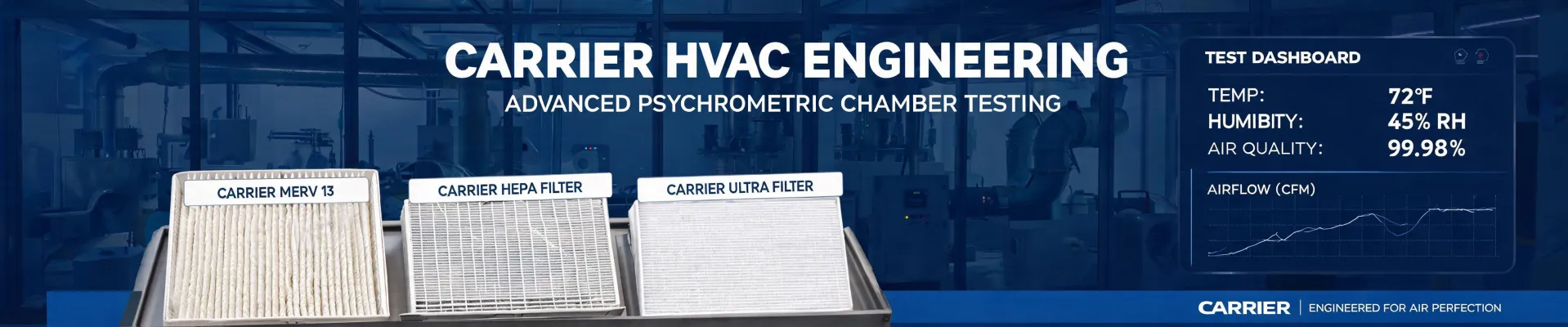
This dimension is about maintenance, and it's the one that surprises people. A standalone air purifier, like a Shark 3-in-1, is useful. Replacing its filter is straightforward: the light goes on, you swap it. But a clogged HVAC filter is a much bigger deal. It raises static pressure, reduces airflow, and can cause the evaporator coil to freeze.
From the outside, it looks like filters are all the same. The reality is MERV rating, depth, and access matter. I've seen a beautifully installed 2.5-ton Carrier system with a filter slot so tight that the homeowner couldn't close the grill without crushing the filter. That's an automatic fail in my review.
If you're comparing HVAC filtration vs a standalone purifier, think of it this way: the HVAC system moves the whole house's air. The standalone purifier is localized. Both can help, but the HVAC filter is the one that protects the equipment. The Shark 3-in-1 air purifier filter replacement is simple maintenance. It's not a substitute for changing your 1-inch HVAC filter on schedule.
A lot of buyers focus on air quality gadgets and completely miss filter access. If you have a choice between a slightly cheaper 2.5-ton unit or a better filter rack, choose the better filter rack. In my experience, it will save more money over five years.
Dimension 4: AC Power Draw vs a Small Chest Freezer
I'm not an electrical engineer, so I can't give you exact breaker sizes here. What I can tell you from an inspection perspective is that people underestimate how much power an AC actually pulls at startup.
A common question I hear is "how many watts does a small chest freezer use?" The answer is not much—usually around 90 to 120 watts running, with a startup spike maybe four to five times that for a second or two. It's small enough that most portable generators handle it easily. But a 2.5-ton AC unit is a different story. Running draw is typically in the 2,500 to 4,000 watt range, depending on SEER and conditions, and startup can be much higher. That changes generator sizing completely.
So the comparison for this dimension is chest freezer watts vs AC watts. It's not a real contest. If a facility manager is planning backup power, the AC is the driver. Don't size a generator based on the freezer you can hear running on the other side of the garage.
So Which Way Do You Go?
Here's my practical take, based on what I've seen in the field:
- If your load calculation says 2.5 tons, don't upsize to 3. You're buying problems.
- If you're installing a variable-speed Carrier system, the COR thermostat is worth the upgrade.
- If you're on a budget, spend money on a solid filter rack and accessible service space before you spend it on a fancier thermostat.
- If you're sizing a generator, start with the AC's startup draw, not the small chest freezer watts.
After six years and over a thousand inspections, I've come to believe that the "best" setup is highly context-dependent. The industry is evolving, but some basics are still basic: match the load, protect the airflow, control the system properly, and register the warranty. That last one is easy to forget until something goes wrong.

Greta Lindholm
Greta Lindholm is a household refrigeration analyst covering French-door, side-by-side, top- and bottom-mount refrigerators, mini fridges, beverage coolers, chest freezers, and upright freezers. She applies IEC 62552 and IEC 60335-2-24 while comparing energy consumption, usable volume, pull-down time, compartment temperature stability, freezing capacity, noise, door-seal leakage, refrigerant charge, and ambient-temperature performance. Her guides help importers, distributors, private-label teams, and appliance engineers select platforms around climate class, storage mix, efficiency labels, cabinet dimensions, service access, shipping density, and warranty exposure.
Leave a Reply