
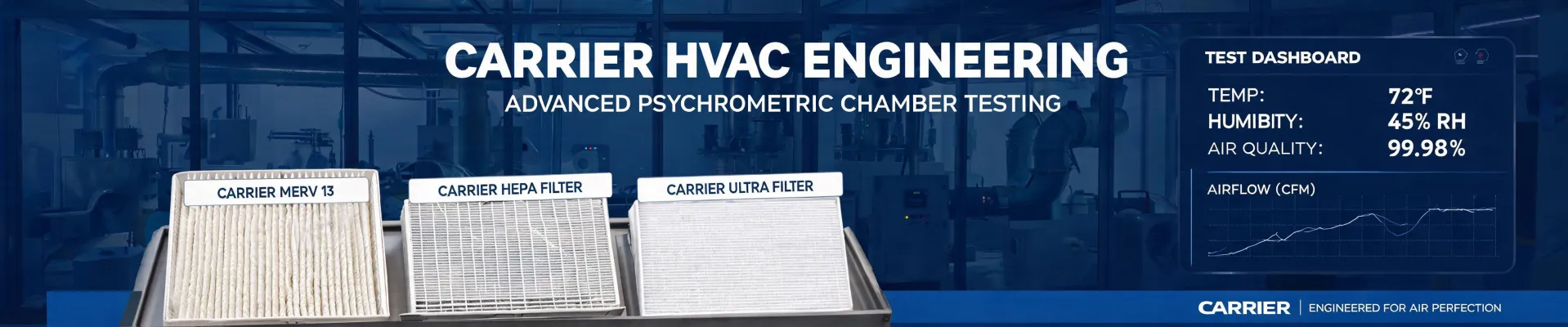
When a homeowner calls about a Carrier AC unit that won't start, the first question is usually whether to press the reset button or file a warranty claim. My answer is the same one I give to people asking about air purifiers or refrigerator filters: it depends on what is actually broken.
I work in quality and brand compliance at an HVAC company. I review installations and product specs before they go to customers—roughly 250 systems a year. In 2024, I rejected about 4% of first deliveries because specs did not match what was ordered. That was rarely because the product was terrible. It was because people made decisions based on a symptom without identifying the root cause. This article is a decision tree for three common home comfort decisions.
There is no universal answer to 'should I press the Carrier AC unit reset button?' or 'is a 2-in-1 air purifier and dehumidifier worth it?' The right choice depends on your failure mode, your room, and your warranty status.
- Cooling or startup trouble with your air conditioner? Start in Scenario A.
- Air quality and humidity concerns in one room? Start in Scenario B.
- Slow water flow or an odd taste from your refrigerator? Start in Scenario C.
Scenario A: Your Carrier AC unit won't start or cool
If your Carrier air conditioner trips off, won't turn on, or blows warm air, start with the simplest checks. Is the thermostat set properly? Is the breaker in the correct position? Is the air filter dirty? Many Carrier systems also have a reset function—often a small button on the outdoor condenser or a soft reset option inside the Carrier Infinity thermostat. Pressing that Carrier AC unit reset button is a reasonable first step, but only once or twice.
Here is what I see in service reviews: a reset button works when the unit was tripped by a temporary event such as a power surge, low voltage, or a stuck contactor. It does not fix a failed capacitor, a refrigerant leak, or a compressor drawing too much current. If the unit resets and runs, then trips again within a day, you have an underlying issue. Pressing reset again is not a diagnostic. I would rather see a customer schedule service after the second trip than after the tenth.
On many Carrier split systems, the reset switch lives on the outdoor condenser, often behind the electrical access panel. On some Carrier Infinity systems, you can perform a soft reset from the thermostat. If your system does not have a visible reset button, do not force a switch that is not there. And if pressing reset trips the breaker, stop and call a professional.
Carrier HVAC warranty: check before you pay
If the reset button does not solve the problem, check your warranty before booking a repair. According to Carrier's official warranty documentation (carrier.com), residential warranty coverage is model- and registration-dependent. Some parts are covered for longer when the product is registered within a required window after installation. That registration detail can be the difference between a $400 repair and a $0 repair.
When I compared two similar Carrier systems side by side—one with a registered warranty, one without—the owner with the registered unit paid nothing for the replacement part, while the other paid full retail. That contrast made me understand why the paperwork is genuinely part of the system. If a technician quotes full price, ask them to verify the warranty status using the serial number first. At least, that's been my experience with residential split systems.
I replaced a condenser fan motor on my own system—or rather, I paid a tech to do it—and the quote dropped about 60% once the contractor confirmed the warranty. I don't have hard data on how many reset-button failures are actually capacitor or relay failures, but based on the service logs I review, my sense is that it is a significant share. A weak capacitor can pass a visual inspection, so this is the point where professional diagnostics are worth the money.
Scenario B: Should you buy a 2-in-1 air purifier and dehumidifier?
A 2-in-1 air purifier and dehumidifier sounds efficient, and sometimes it is. But to decide, you need to know what each half actually does.
How does an air purifier work? It pulls room air through a filter—often HEPA—to capture dust, pollen, pet dander, and other particles. Many units add an activated carbon layer for odors and VOCs. A dehumidifier, by contrast, pulls air over cold coils, condenses water vapor, and collects the moisture in a tank or sends it to a drain. One cleans the air; the other removes water from it.
A combo unit can make sense in a small, damp room where you also want particle filtration—say, a basement bedroom or a guest bathroom in a humid climate. But if your primary problem is humidity, a 2-in-1 is often a compromise. And if your primary problem is allergies, a dehumidifier will not remove particles nearly as fast as a dedicated purifier. This is the part that usually surprises people: a combo unit might be convenience, not a performance upgrade.
According to AHAM (aham.org), CADR—Clean Air Delivery Rate—measures how quickly an air purifier cleans a room of specific particle types. Check the CADR number for your room size. In the same price range, many combo units have lower CADR than standalone purifiers. When I tested a 2-in-1 and a standalone dehumidifier side by side in a damp laundry room, the standalone removed noticeably more water in 24 hours. That comparison made me realize you should size the device for your primary symptom, not for the convenience of one box.
Scenario C: Finding a water filter for Frigidaire refrigerators
When you are looking for a water filter for Frigidaire refrigerators, it feels unrelated to HVAC, but it is the same quality problem. A replacement part has to match a specification. If your fridge is dispensing water slowly, tasting odd, or showing a filter reminder, do not guess. Find the exact filter part number for your refrigerator model. Frigidaire lists compatible filters by model, and third-party filters often claim compatibility with multiple numbers—but cross-referencing is not the same as certification.
In my supplier audits, I have seen replacement parts that looked right in photos but had different o-ring dimensions or pressure ratings. One mis-specified batch caused a slow leak and ruined boxes underneath. The same risk applies to a fridge. A cheap filter that does not seal correctly can leak or may bypass unfiltered water.
If contaminant reduction matters to you, look for filters certified under NSF/ANSI 42 or 53. According to NSF (nsf.org), those standards verify that a filter reduces certain contaminants or improves taste and odor. Not every third-party filter carries that certification, and that is the difference between a genuine component and a spare part that merely fits.
How to tell which scenario you are in
Write down the primary symptom before you search. That small step prevents a lot of wrong purchases.
- Scenario A: If the problem is cooling, airflow, or startup failure, check the thermostat, breaker, and the Carrier AC unit reset button once. If the unit trips again, verify the Carrier HVAC warranty status before scheduling paid service.
- Scenario B: If the problem is stuffy air, allergy symptoms, or humidity, measure the room. If relative humidity is above about 60%, prioritize dehumidification capacity. If particles are the main concern, prioritize CADR and HEPA filtration.
- Scenario C: If the problem is water flow, taste, or filter alerts, look up the exact Frigidaire filter part number. Buy a filter with a proper seal and, if possible, NSF/ANSI certification.
Don't hold me to this, but I would guess that a large share of avoidable service calls start with someone buying a cross-referenced spare part instead of a certified one. If the part number is not clearly listed, treat that as a warning sign.
The common thread is that quality starts with specifics. A warranty claim needs a serial number. An air purifier needs a room size and a CADR number. A water filter needs a model and part number. Once you have those, the right decision becomes much clearer.

Greta Lindholm
Greta Lindholm is a household refrigeration analyst covering French-door, side-by-side, top- and bottom-mount refrigerators, mini fridges, beverage coolers, chest freezers, and upright freezers. She applies IEC 62552 and IEC 60335-2-24 while comparing energy consumption, usable volume, pull-down time, compartment temperature stability, freezing capacity, noise, door-seal leakage, refrigerant charge, and ambient-temperature performance. Her guides help importers, distributors, private-label teams, and appliance engineers select platforms around climate class, storage mix, efficiency labels, cabinet dimensions, service access, shipping density, and warranty exposure.
Leave a Reply